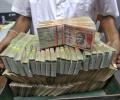
The rupee fell because of fresh demand for dollar from importers.

The NSE Nifty ended 55.75 points, or 0.57 per cent, higher at 9,912.80 after moving between 9,925.75 and 9,882.
The rupee had shed 10 paise to close at 66.14.

Expectations of good foreign capital inflows into equity market in view of firm trend in the stock market also boosted the rupee value against the dollar.

Monday's morning trade sees increased selling of USD by exporters.

The report said that "we believe, institutions are more important than individuals" and ultimately what is important is the credibility and the independence of any institution and nothing else.

The rupee closed at Rs 66.21 in its last trading session.

The rupee gained 28 paise on Thursday to close at 62.50.

Reliance is in the market with a benchmark issue to sell 30-year US dollar-denominated Reg S fixed rate senior unsecured notes.

L&T was the top loser in the Sensex pack, dropping 4.99 per cent, after the engineering major posted a 45 per cent decline in consolidated net profit for the September quarter. Titan, ONGC, Axis Bank, HUL, NTPC, M&M and HDFC were the other major laggards, shedding up to 3.32 per cent. NSE Nifty fell 58.80 points or 0.50 per cent to 11,670.80.

Rupee ends day at 61.91 against the US dollar.
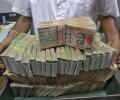
The domestic currency had lost 10 paise to close at 59.03 against the dollar in Thursday's trade amid capital outflows linked to fall in equities.

Government is also will also enter into an agreement with Japan for a $50 billion swap.

Recovery in the equity market also boosted the rupee value against the dollar, a forex dealer said

Bajaj Auto was the top laggard in the Sensex pack, tumbling around 6 per cent, followed by M&M, Reliance Industries (RIL), Tata Steel, Tech Mahindra, SBI, Axis Bank and ICICI Bank. NSE Nifty tumbled 162.60 points or 1.36 per cent to 11,767.75.
.jpg)
Chidambaram said recent measures taken by the Reserve Bank of India were aimed at reducing volatility in the financial market, where the rupee has dropped to record lows.

The financial market gave a thumbs up to Reserve Bank of India's annual credit policy, which pushed up the benchmark Sensex higher by over 225 points and lifted the Rupee to over a nine-year high.

Silver coins continued to be sought after at the last level of Rs 77,000 for buying and Rs 78,000 for selling of 100 pieces.
.jpg)
Fag-end dollar selling by exporters helped the rupee to recover lost ground and settle at the day's high of 60.77, a gain of 11 paise. The rupee earlier touched an intra-day low of 61.21 on July 8.
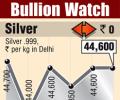
However, FII outflows of Rs 545 crore (Rs 5.45 billion) capped the gains in the rupee, which had slumped by 126 paise in past two days.

The rupee appreciated 7 paise to 79.74 against the US dollar in early trade on Thursday as a positive trend in domestic equities supported the local unit. However, a strong American currency overseas and forex outflows restricted the rupee's gain, dealers said. At the interbank foreign exchange, the rupee opened at 79.72 against the American dollar, then went lower to trade at 79.74 against the greenback in early deals, registering a gain of 7 paise over the last close.

There was fresh dollar demand from banks and importers.
The rupee firmed up by 15 paise to close at 62.36 per dollar on fresh selling by banks

If the war in the Israel-Gaza region escalates into a larger West Asian conflict, it could pose problems.

ICICI Bank was the top gainer in the Sensex pack, rising around 3 per cent, followed by Axis Bank, HDFC twins, SBI, L&T, ONGC and Infosys. On the other hand, Sun Pharma, Asian Paints, Nestle India, UltraTech Cement and HUL declined. NSE Nifty rose by 79.60 points or 0.67 per cent to 11,914.20.
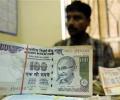
Indian rupee washed out initial losses against the greenback.

Strong rebound in local equities restricted the rupee's fall.

The steep decline in commodity prices has reversed.

The dollar index, which tracks the world's reserve currency against a basket of its peers, is down 0.16 per cent at 97.58.
The Bombay Stock Exchange (BSE), the National Stock Exchange (NSE), Forex, Money, bullion, metals, oils and oilseeds, cotton, grains and solvent markets will remain closed on April 30 and May 1 for Lok Sabha elections and 'Maharashtra Day', respectively.

Vikram Kothari's Rotomac stares at a loan default of Rs 369 crore

Lower dollar in the overseas market also boosted the rupee value

Falling for the third day, Indian rupee on Wednesday weakened by 14 paise to close at over one-week low of 62.02 against the Greenback.

The rupee on Tuesday fell by 25 paise to 65.05 on fresh dollar demand from banks and importers despite persistent foreign capital inflows.

Hopes of more foreign funds on the back of sharp recovery in domestic equity market also boosted the value rupee against the dollar

Increased demand from oil importers for the American currency and a weak opening in the domestic stock market also put pressure on the rupee.

Tracking local stocks, rupee on Tuesday regained 19 paise to end at 61.85 against dollar as reports of easing geopolitical tension between Russia and Ukraine helped emerging market currencies script a smart recovery.

The Indian benchmark S&P BSE Sensex today eased by 14.59 points, or 0.05 per cent after touching its all-time intra-day peak.

A smart rebound in the stock market and sustained capital inflows restricted the rupee loss
